


According to the international classification of diseases, lumbar osteoarthritis belongs to the tenth group (ICD 10).This disease is one of the most commonly diagnosed spinal disorders.

Changes and complications during the course of the disease lead to the formation of hernias between the vertebrae, causing severe pain and dysfunction of the intervertebral discs.
This disease is noted in 80% of patients who seek help for lower back pain.As a rule, osteochondrosis occurs in old age due to:
- increased loads throughout life involving the lower back,
- lime salt mine,
- age-related changes.
Description and symptoms of the disease
Characteristic signs of lumbar pathology include the following:
- reduced flexibility and mobility;
- difficulty turning, turning, or tilting the body;
- general fatigue;
- sleep disorders;
- difficulty meeting natural needs and self-care due to pain;
- irritability, sudden sweating;
- cold or tingling legs;
- signs of spasm in the arteries of the foot;
- sexual dysfunction (in men), menstrual cycle (in women);
- varicose veins.
In fact, the question of what is lumbar spondylosis can be answered with the following arguments:
- Reduces the distance between intervertebral discs, disrupts their function, loses moisture and elasticity.
- Excessive tension and chronic weakening of the spinal muscles.
- The shock-absorbing ability of the intervertebral disc is impaired, partially deformed and affects nerve endings, leading to pain (applies to stages 3 and 4 of the disease).
Disease progression
The development of pathology occurs gradually.People often distinguish 4 stages of medical history:
- The first degree is manifested by local pain in the lumbar region, which intensifies during physical activity.This symptom signals that the muscles are being overstretched and the deforming process of the disc has begun.In addition, patients at this stage may feel a dull pain in the back, spreading to the buttocks, tingling and burning there.As a rule, pain occurs after carrying heavy objects or making sudden movements.
- Stage 2 of the disease is characterized by the beginning of deformation of the surrounding tissues, the fibrous annulus of the intervertebral disc and a decrease in the natural distance between the vertebrae.Compression (squeeze) of the nerve roots also develops.At this stage, the patient may feel sharp pain that gradually increases when walking.There may be a burning or cold feeling in the legs.The intervertebral disc stretches and protrudes.If a pain occurs, the patient automatically deflects in the opposite direction to the origin of the pain syndrome.
- The third degree is characterized by the final destruction of the intervertebral disc rings and the appearance of intervertebral herniation.Lower back pain becomes more frequent and stronger, spreading to the legs and back, regardless of load and movement.
- The fourth stage of osteonecrosis is characterized by abnormal development of the vertebrae.Cartilage undergoes significant atrophy.The pain may decrease, which indicates the formation of protective tissue, but this is not a sign of recovery.The disease at this stage often leads to disability in the patient.
Comorbidities
The almost identical manifestations of the disease in question are characterized by deformity of the spondylolisthesis in the corresponding part of the body.This disease belongs to the final stage of osteonecrosis and has the following symptoms:
- feeling of heaviness in the back, especially the lower part;
- acute pain in sitting position, when moving;
- lower back pain when bending, stretching and other movements.
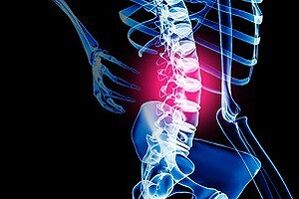
This disease is characterized by significant changes in the vertebrae with the formation of bony growths that irritate the spinal ligaments.The overgrowth (osteoporosis) can reach significant sizes, causing fusion of parts of adjacent vertebrae and pressure on nerve roots.
The consequences of the disease, in addition to pain, can also include reduced mobility, discomfort when the weather changes, and disability.
The disease mainly develops in old age due to excessive stress on the lumbar region and the deposition of lime salts.In young people, spondylosis can develop due to curvature of the spine and improper distribution of loads on the back muscles.
Exercise, physical therapy and health-enhancing medical procedures
The disease cannot be completely cured.The first two stages of spinal health problems can be healed quickly and permanently.In addition to drug treatment prescribed by the doctor after an appropriate examination, patients are also instructed on physical procedures and exercise equipment to treat lumbar spondylosis.
These include:
- massage - can relieve pain, strengthen muscles in the lumbar region and relax problem areas.
- Physical activity, exercises to strengthen back muscles.
- Amplipulse, magnetic resonance effect.
- Iontophoresis and electrodynamics.
Optimal results in the treatment of osteoarthritis of the lumbar spine are achieved by an integrated approach using traditional therapy, massage, physiotherapy and traditional medicine.For prevention, you should strengthen your back muscles, do not avoid physical activity and monitor proper nutrition.Also, don't forget to promptly treat other back diseases and maintain a healthy lifestyle.